Showing posts with label Bernice Bailey Calvert. Show all posts

Tuesday, October 13, 2009

My Mother Slept Here (and here)

I don't know where exactly George Washington slept around here, but I do know that my mother, Bebe Calvert, gave him a run for the money. Her family moved at least eight times while she was growing up, and all of those addresses were within the confines of the District of Columbia starting with the old Sibley Hospital on North Capitol Street where she was born in November 1917.


For my mother's birthday, I planned a tour of all her former residences, but first we needed sustenance. We stopped in at my favorite place for soul food, the Hitching Post, where we had a fabulous fried chicken feast. The proprietors, Mr. and Mrs. Carter, have held the fort here since 1968, and their place feels more like a home than a restaurant.


After the birthday lunch, we headed just down the street to 1346 Quincy Street in Petworth. The family lived in a four bedroom row house, squeezing in Bebe parents, her grandfather Papa Bailey, two teenaged aunts, Mary Bess and Johnnie Pearl, plus a lodger to help make ends meet. The grand total was seven people. One bathroom.

Built in 1918, these homes were fairly new when my family lived there in 1922. As far as I can tell this was the second place the family lived- the first being 2107 F Street-"near the gas works" according to my mother. This picture was probably taken in 1919.  George Washington University owns the building now.


At that time Bebe's father Roger was running "Calvert Commercial Service "opening doors" for newcomers in Washington. Roger came to town in 1916 to work for Senator Sharp Williams of Mississippi so he felt he knew the ropes.  The company motto?  "We do not pretend to know everyone, but we know someone who does." The office was at 1402 F Street and in a letter home, he mused to his mother that he could walk two blocks to the White House and see the President, but couldn't get away to visit the family in Mississippi. He wasn't kidding. He goes on to mention a photograph of President Harding holding my mother's hand taken in August of 1921.  I sure wish I had that picture.

My mother's little brother Roger Jr. was born in late November of that year also at Sibley Hospital. They called him "Sonny."


The family was outgrowing F Street when they moved up to Petworth and then on to Mt Pleasant where they would settle for a few years. Sonny was baptized at Mt Pleasant M.E. Church by Brother Ray. Their next address, 1370 Irving Street is now billed as "new luxury condos." They moved again when Roger got a job managing the Argonne Apartments, built in 1921 at 1629 Columbia Road. That building is still standing. The family lived in two different apartments there.


They also lived in the Chalfont which was built in 1918 on Argonne Place. Bebe remembers lying in her bed at night and hearing the lions roar at the National Zoo down the hill.


In early 1929 their address was 2606 Motzart Place. The house is still there although the big side yard where my mom climbed a tree has given over to a parking lot just like Joni Mitchell predicted.


Bebe remembers there was a fireplace angled between the living room and the hall to the kitchen, and that she could walk out her back door to HD Cooke Elementary which was on the other side of the block.

Cutting across town we passed by the rather grand Broadmoor on Connecticut Ave. My grandparents were the first managers when it opened in 1929 just before the Big Crash. They lived in at least 4 different apartments there. (Is anybody keeping count?) Here's Bebe at age 16 hanging out with a few friends in front of the lamp post.
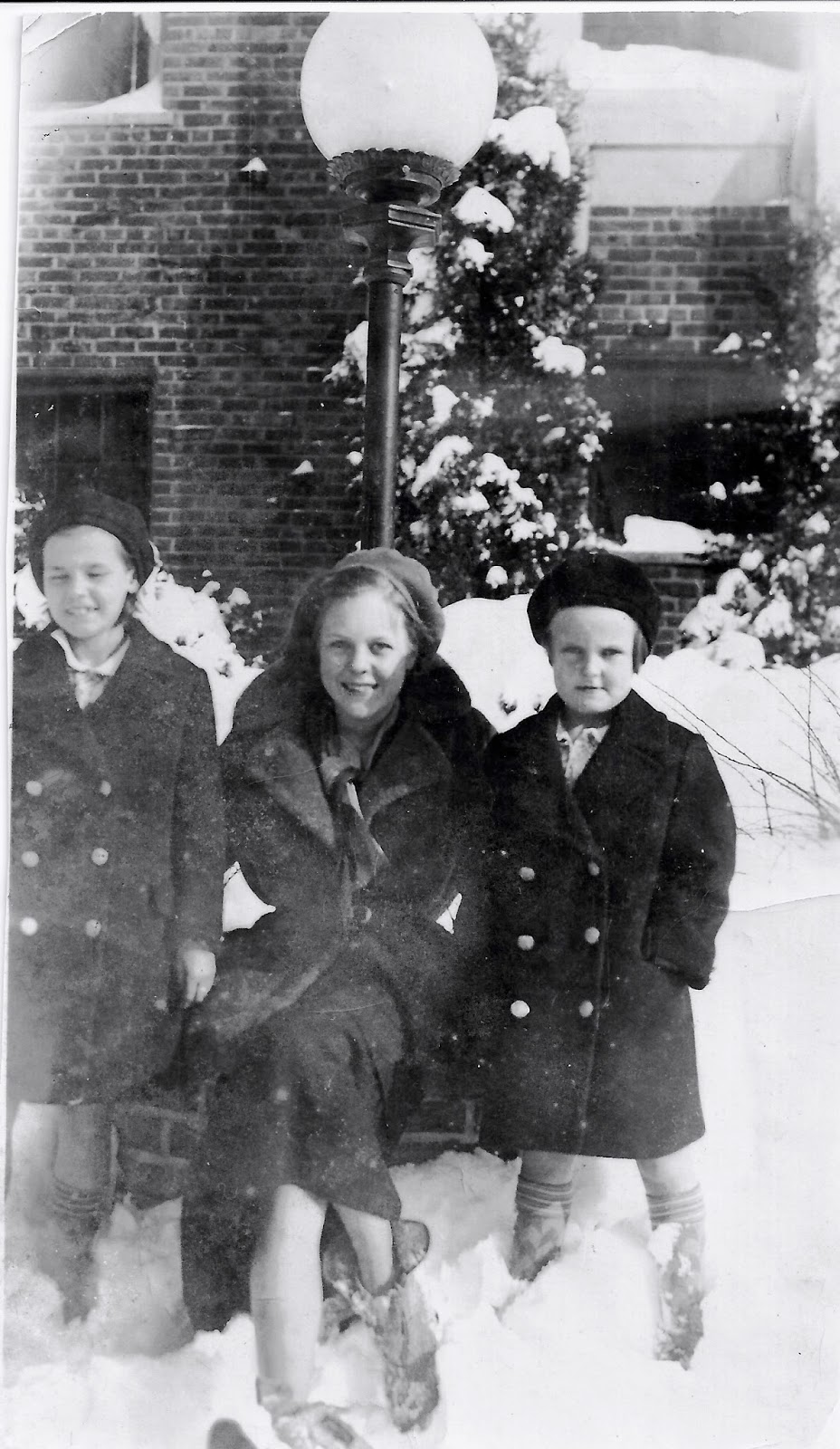


And here she is a few years later. (I didn't realize I took this picture in almost the same spot until I found the old one.

Back out on the Avenue, I thought we were finished when Bebe started waving at yet another building on the corner of Connecticut and Ordway. I veered over to the curb and found out that she lived there until she graduated from Western High School in 1935, and it was from this place that my mother left home for good and started another series of moves around DC. This time with my father.

Friday, December 07, 2007

Remember Pearl Harbor


In our family, we learned to remember Pearl Harbor early in life because of my grandmother Bernice Calvert. She was an eyewitness to the attack, but her journey to Hawaii started here in Washington, DC.

In 1933 Bernice, a young widow, was managing the Broadmoor Apartments on Connecticut Avenue. She met her next husband when he was playing violin at the Broadmoor's afternoon teas. Bernie was from New York, but came to Washington to attend medical school at Georgetown. The gig gave him some spending money.


Bernie was a charming and talented guy.  He did this sketch of Bernice on the back of his business card. They were married on November 4, 1936.


When Bernie graduated from Georgetown, he accepted a commission in the Medical Corps Reserves and was called into active service in April of 1941 in the territory of Hawaii. Not knowing this trip would be much, much longer than anticipated, they rented out their house, climbed into their car and drove to San Francisco, stopping along the way to take in Old Faithful and other sights out West.


In California, they were stalled for weeks waiting for a transport ship. They killed some time in Los Angeles where they met movie stars like Marlene Dietrich thanks to an MGM studio pass Bernie had scored from his musical connections. A diary mentions lunch with "Spencer and Gable,"  and an encounter with Charlie Chaplin and his family at the bird zoo in Catalina. Bernie remembers chatting up Chaplin and being allowed to take a photo with Pauline Goddard.  (Boy, I wish I could find that shot.)


Finally a Matson Line ship became available. Bernice and Bernie arrived in Honolulu in early July. Back then travelers were traditionally greeted by Hawaiian women with armfuls of leis, but they also saw waves of P-40s and bombers dipping their wings to say "hello" to the new crew. As the ship docked, the Royal Hawaiian band played "Aloha Oe" and other native songs while crowds below shouted and waved. 


After watching a sunset near Diamond Head, Bernie wrote "It was like having walked all your life in a haze and in muck- then suddenly breaking through the mist and seeing a great panorama in front of you."

The attack came just before 8 a.m. on a Sunday morning, Bernie's day off. A neighbor woke them by pounding on the door and shouting. Bernie, in shock, turned on the radio to confirm the unbelievable news. A broadcast of a church service was soon interrupted with the announcement:  "The island of Oahu is under enemy attack...all officers report...all citizens stay off the streets. Keep calm. Everything is under control."  Bernie got dressed, and still feeling dazed, left for Tripler with the captain who lived next door. On the way they saw billows of black smoke rising from the harbor, and three low flying planes. The news became all too real.


At the hospital, the scene was pure frenzy. Wounded civilians and soldiers, both dead and alive poured in all morning.  One victim was carried in on a street sign. A bomb dropped so close to the hospital that a convalescing patient died from shrapnel wounds. Many young soldiers urged Bernie to take care of others before themselves. Towards midday Bernie went home to collect his surgeons' tools, but a crowd stood in the street, blocking the way. It took a moment for Bernie to realize that the front of his house was almost demolished. Most of the windows had been shattered by shrapnel.

The concussion of a bomb, which fell across the street from their home, had knocked Bernice to the floor, but amazingly, she only suffered a twisted ankle. Bernie found his wife at a neighbor's house and took her with him back to the hospital.  Bernice washed instruments and cut bandages while Bernie went back to the surgery. They worked through the day and most of the night.

I don't have a photo of the hospital, but I found the photo below with Bernie's things. He was an avid photographer so he may have taken this himself; there are no official markings on the back.


Almost all of the Army wives and children would leave the islands as soon as possible, but my grandmother wanted to stay despite the curfews, blackouts, and a new life which included gas masks always at the ready.


Bernice became a censor at the post office and volunteered with the Red Cross.


By February 1942,  she wrangled a full time position as a paid social worker for the Home Service of the Red Cross. Her evacuation was deferred.


Bernie and Bernice also organized a theater group and gave performances throughout the islands before the USO made the scene. (I wonder if she was rethinking her decision in this shot taken in their living room probably around Christmas of 1942.)


Bernice witnessed both the beginning and the end of the war first hand.  My mother told us that she was the only woman correspondent to cover the war in the South Pacific, and that she was aboard the USS Missouri when the Japanese surrendered.

 After the war, Bernice remained on the islands helping the Red Cross pick up the pieces of many altered lives.  She never lost her love for all things Hawaiian and stayed overseas for twenty years.