Tuesday, February 22, 2022

Potomac Heights: Have You Seen It?


In the summer of 1909 a new "suburb" called Potomac Heights opened in the Northwest corner of Washington, DC. At the time only a semi- abandoned athletic park with a race track for bicycles existed on this edge of the city. The track, which opened in May of 1896, was nestled near the corner of Macarthur Boulevard and the Dalecarlia reservoir where an alley with a deep approach is now. 


1903 Baist Map


An article in the Evening Star had this description: "there are no obstructions in the entire area, and the only landmark is a solitary tree, which stands about the center of the place, and in the side of which, as a mark and a relic of bygone days, a piece of bayonet is firmly held, which was undoubtably imbedded in the tree doing war times, when the place was used as a camp by soldiers." Yep, that was a while ago.

An estimated 18,000 yards of earth were removed to create a sunken amphitheater effect with the course being one third of a mile long.  The president of the company,  Jacob P. Clark, was also the president of the Great Falls Electric Railway at the time. Housing development plans were alluded to, but never came to fruition. Here's a drawing of the bike track.


On June 16, 1909 a group of real estate men from North Carolina bought the 75 acre property which was still mostly undeveloped land, described at the time as "a maze of timothy oats and undergrowth."  The tract was one mile long, bounded by Arizona Avenue, the Dalecarlia reservoir, MacArthur Boulevard, and the bluff of the river.   JD Dorsett, R H McNeil and JM Maupin called their new corporation "The Potomac Heights Land Company." 

The new neighborhood would be three blocks wide, bisected by what was then the Glen Echo trolley line which provided the convenience of a streetcar to anywhere in the city.  Originally about 800 lots were planned with two acres donated to become Carolina Park by the developers where "walled springs under wide-spreading branches provided deliciously cold water." The springs are mostly forced through tunnels today, but one still meanders close to Macomb Street. The lots were 25 feet wide, and buyers were encouraged to purchase two at $800 a pair with financing available "for less per month than you pay a good cook."


 Potomac Avenue, a brand new road, was described in an Evening Star article on June 3, 1911 as "extending along the very brow of the hill and commanding a magnificent view of the Potomac River and the valley." As beautiful as the topography was, and still is, land near the river was not traditionally considered to be desirable. In the 1920s Chain Bridge led to a gas station and a tavern on the Virginia side. A watering hole had anchored that side of the bridge ever since one took the place of an abandoned Civil War guard station. 


photo from Library of Congress

Due to flooding, Chain Bridge has been replaced many times, and first got its name from a suspension bridge version  in 1808. The current stone piers have been in place since just before the Civil War. Various taverns came and went as well. During Prohibition in the 1920s, McKey's Tavern was known as a bootlegging outpost. I love this noir type shot.


Taken from parking lot of McKeys Tavern 

Of course, the DC side of the bridge had its own share of shady goings ons. In August of 1927, eighteen men and women were arrested for disorderly conduct, and three for bootlegging during a midnight raid on a house at the corner of Canal Road and Arizona Avenue. A thousand bottles of home brew and liquor were seized. In the summer of 1933 undercover cops in bathing suits arrested two entrepreneurs on a houseboat who had been "catering to canoeists and swimmers all summer doing a particularly heavy week end business." Business was booming. The cops seized a dozen quarts of their "alleged whiskey."

A girls' reform school, which opened in 1893 on the site of the present day Sibley Hospital, flanked one end of the neighborhood- just across the road from the bicycle track.

Reform School Admin Building 1937

In 1921 eleven girls escaped from the reform school. Thirteen men and women were later arrested for harboring the runaways, several being caught while "enjoying life in Marquise Camp" south of Chain Bridge according to a story in the Evening Star. A motorboat called "The Vamp"was raided and yielded more arrests. The girls reported that they "were motored about the river" and that bathing suits were acquired for them. I have a feeling their benefactors were not well-intentioned. 

Life was both rural and blue collar here in the early 1900s. Fishermen and laborers lived in shacks which dotted the bluffs on both sides of the river. Quarries lined the Virginia side from near Spout Run to Pimmet's Run by Chain Bridge. Barges still ran up and down the canal delivering everything from coal to ice cream until a flood in 1924 basically shut down operations.  Here's a canal barge serving as a party boat in June 1916.

Canal Party photo by Willard Ross 

The B and O Railroad ran a line from Georgetown along where the Crescent trail is now, but Chain Bridge was often the scene of recreation as much as commerce as this "Chain Bridge Hike" in June of 1916 portrays.

Postcard by Willard Ross

The Potomac Height Company capitalized on the natural beauty of the area with advertisements proclaiming the benefits of healthy living with city conveniences. "Your home -within 5 cent street car fare of Washington-on the healthful level of 150 feet above and overlooking the most beautiful part of the Potomac-that's what awaits you..."


 Many subsequent ads hinted that the neighborhood would soon be lake front property. For decades plans to harness the river's energy were pondered. The Great Falls Manufacturing Company which later reorganized as the Great Falls Power Company retained riparian rights starting in the 1839 even though the river was within the jurisdiction of Maryland. A massive hydro-electric dam was proposed in the 1890s. The lake would be named after Montgomery Meigs, an architect and engineer who oversaw the construction of the Washington aqueduct which included a feat of engineering now known as the Cabin John Bridge. The 220 foot masonry arch was the longest in the world for about 40 years after its creation. 

In 1864, Meigs, a fervent supporter of the Union during the Civil War, was Lincoln's quartermaster and later a self imposed doorman when Lincoln lay dying at the Petersen House. It was Meig's who had the vengeful idea to bury soldiers in Robert E. Lee's yard and turn the grounds into Arlington Cemetery.

Montgomery Meigs Library of Congress

But I digress.  

The powers-that-be finally came to their senses in 1927, when the National Park and Planning commission realized a dam would be environmentally ruinous, attract unwanted heavy industries, and possibly  "imperil" the Lincoln Memorial and the Washington Monument downstream if breached. About ten years later, the government bought the C and O Canal from the B and O Railroad.

The most disturbing history of Potomac Heights can be found in 1911 when an ad in the Evening Star listed 15 "good" reasons to buy property here, the number one being "because the property is in a splendid neighborhood and free from persons of African descent." 


This ad was the most blatant I found, but not a one off by any means. Advertising pitches repeatedly emphasized that "only the best people" could buy homes here, and deeds with racial covenants were not outlawed until 1957. In July 1919 an ad in the Evening Star had this abhorrent description of home sales in Potomac Heights: "Under stringent restrictions. It will always be white." And that's pretty much what happened.


Development of the neighborhood preceded slowly. Sears and Roebuck, the mail order company, began selling homes in 1908, but the DC market took off in 1922 when a local sales office opened on 10th St NW.  Sears kit homes came in a stunning array of both styles and materials and were a popular choice for those investing or moving to Potomac Heights. 

In 1923 The Potomac Heights Community Church forged connections between many of the new neighbors. The only church in the area was Catholic, and since there weren't enough Baptists or Methodists to make a difference, a group of neighbors decided to join the community church movement and merged eleven denominations into one church.

Now many of those homes are making way for newer bigger buildings- especially on lots overlooking the river.  My block of Potomac Heights has two Sears homes, including my own. This year, listening to all the hammering nearby,  I wondered who first lived on this block. under the shade of our 100 year old willow oaks? Stay tuned to this site for those House Stories. 


Wednesday, January 26, 2022

The Hollywood Inn of Maryland


By the
time my father George was twenty years old, he was supporting his wife Bebe, a young son Peter, and a new baby. My grandparents Pota and Pete were still crazy upset that my parents had eloped in 1935, and that my mother was not a Greek girl. Pota still refused to accept the situation, but in 1937 when my sister was born, my grandfather Pete was ready to cave. He had bought property near Camp Springs some time in the early 1930s thinking the urban congregation of St Sophia's might want to use the grounds for picnics and gatherings. The Hollywood Inn, as it was called, was near the middle of nowhere in an area so rural, it didn’t have a street address. The area which was once known as Red's Corner or Meadows. Unfortunately the church thought the place was too far from the city and not as much fun as an excursion to Marshall Hall. Pete upped his game when he secured a license to sell beer in June 1933 as soon as regulations prohibiting the sale of beer were relaxed and before the official end of prohibition at the end of that year. Here's a Hollywood Inn ad from 1934.


And here is a photo of the family on the front porch around 1935. My grandfather Pete is in the back standing between his brother Alec and his daughter Catherine. The front row is son Nick, Alec's wife Koula and my grandmother Pota. The children belong to Koula and Alec. My father is in the very back grinning.


After my sister was born, Pete decided to let his son live there in exchange for running the roadhouse. During the week, George worked for Quick Service Laundry. When he was out driving the delivery truck, he would put flyers on parked cars advertising Saturday night dances and chicken dinners on Sunday at the inn. (Chicken plucking was also on his resume.)   

I am guessing my father got an extra good deal on these business cards because his name is misspelled.


I only have one rather desultory photo of the Inn's interior. Seems like everyone is waiting for Godot including my grandfather Pete who is standing to the right of the stage.


Both of my parents grew up in the city. This was their first run at life in the
country with chickens, dogs and cats. I love this goofy photo of my sister sharing her playpen with a dog and puppies. Her brother Pete has his head at the bars.


One memorable Saturday, the Inn was rented out to a group who wanted to have a "smoker."
George had no idea what was involved until the entertainment arrived. My father took one look at the four dancers and decided he should ask my mother to leave her hostess stand and stay upstairs for the rest for the evening which, as it turns out, was cut short by a raid. As my father told it, a nosy neighbor caught wind of the affair and called the police. The incident garnered a mention on the front page of The Evening Star on February 5, 1938. My father was arrested and fined for his ignorance, but he always loved to tell the story.


A year later the word "smoker" took on a whole new meaning on a windy night in March.  My parents hosted a friend's birthday party earlier in the evening. They had cake and danced, mostly to "Hold Tight" which was in heavy rotation on the music box as my mother called it in her journal. The party broke up just before midnight, and after shutting down the Inn, my father fell asleep while Bebe was reading in bed. She heard rustling noises in the attic and wondered why they still had rats with all of the new cats roaming the property. She woke up George, and after listening a moment, he went down the long hall to investigate. When he pushed open the trap door to the attic, he discovered flames and yelled back to my mother to wake the household which included their helpers Mary Louise and Horace. They left the building at 12:15. My father went back in with Horace to try and save a few things, but it was too smoky. Half of the building was already consumed by flames.  George drove his DeSoto four miles to the Forrestville fire department to get help, but by the time he returned, the inn had burned to the ground. The devastation took less than forty five minutes, and the recruited firemen used their resources to save the woods and neighboring houses. 

George and Bebe lost everything that night except the clothes on their backs which were pajamas. They stayed with a neighbor and had to borrow clothes to drive into town the next day. Pete eventually sold the property to Andrews Air Force Base. My father found an apartment on E Street a week later, and they started over from scratch with donated clothing and furniture.


Sunday, December 01, 2019

Old School Part One


My father George started kindergarten at Wheatley Elementary on Neal Street NE in the fall of 1921. His sister, Catherine dragged him to school by the hand, and he cried the whole way. The teacher kept asking him his name, and he kept telling her “Yorgo.” They both must have been mystified. "Yorgo" didn't speak English, and he remembers being the only Greek boy in the class. The only friend he can recall from those early days was Harry Chase who lived up the street and did scary shows in his basement. (Isn't there always one?)

Henry Cooke 1926 (Roger front far left)
Meanwhile, in Mount Pleasant, my mother Bebe and her little brother Roger attended Henry D. Cooke on 17th Street NW.  Cooke was unusually large and overcrowded for an elementary school in the 1920s, and Bebe was a shy little girl.  She didn't like going to school. She remembers being locked in a closet, but she doesn't remember why.

In 1929, the family moved to the brand new Broadmoor Apartments on Connecticut Avenue and Porter Streets in Northwest.  The children in the building had their own little bus which took them to John Eaton Elementary on Lowell Street. One of those children was John Hechinger who would grow up to be a hardware magnate and start a chain of stores in our area. Bebe’s only good memory of John Eaton was the bakery truck which came around at recess. She was always torn between the eclair and the cinnamon bun.


Roger and Bebe

My father’s family also moved to Cleveland Park in the 1920s. George, Catherine and their little brother Nick all attended John Eaton starting in 1926. George remembers at recess a truck came from Holmes Bakery to sell treats. My mother Bebe, who also went to John Eaton, liked the cinnamon buns, and George liked the eclairs.  George remembers that John Eaton was bigger than Wheatley and had a better playground. 


The Cokinos children walked the quarter mile from Macomb Street to school until George got a bicycle. Between owning a bike and getting a recommendation from his neighbor, Mr. Burka, of Burka’s Liquors, George became the first captain of the first boy patrol in the city. He remembers being in the sixth grade which would make the year about 1927. He kept his badge all his life.


His little brother Nick followed in his footsteps about four years later. Here's a picture of him and his fellow officers. (Click on the photo to enlarge)

Nick- 4th from right second row (1930s)

Most of the elementary schools went from kindergarten to the eighth grade in those days which would date this picture of Catherine's graduation sometime around 1929.


Catherine second row second from left

Saturday, December 29, 2018

Part Three: The Cokinos Brothers Go Their Separate Ways /Macomb Street

Hain's Point abt 1920 Pete, Pota, Katy, Adam and little George

The Cokinos Brothers and cousins came to Washington, D.C. from Greece in the early 1900s. My grandfather Pete and his brothers Adam and Alec lived above the various candy shops they ran until they had enough money to do other things. Adam and Pete both bought homes for their families near the shops on 9th Street NW and H Street NE, but those two had very different ideas about their retirement gigs.

In 1922 Adam bought a fifty acre farm on the Rockville Pike at Montrose Road in Montgomery County, Maryland. Today a mixed use development called Pike and Rose has replaced the barns and fields, but in those days the fifty-six acre tract was known as the National Vaccine and Anti-Toxin property, 

Here is a picture of the original farm house which was built with rammed earth and stone by Rudolph Gaegler in the 1850s or so.


Adam wanted to have a farm to table kind of place which would supply restaurants with fresh produce. Unfortunately his property manager smoked in bed and burned the place down.

At least that’s what my father always told me.

I discovered a more harrowing explanation in a Washington Star article from July 1925.  John Cooley, the property manager and his 35 year old son Jesse were living in an outbuilding on the farm. According to the article, poor Jesse was pumping the kitchen's coal oil stove when it exploded. His clothing caught on fire, and a neighbor severely burned his hands trying to get Jesse’s clothes off. In desperation, Jesse ran to a nearby creek to douse himself, but it was no use. A passing motorist took him to a hospital where he died.
Adam never did move to the farm, and after this unhappy event, he sold both the property and his candy store. He moved the family up to Philadelphia where his wife Katy could be near her folks again and started a coffee company. 

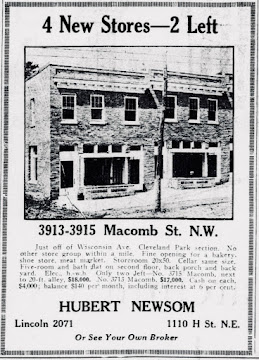
In 1920 Pete bought property on Macomb Street back when the street car turned here off Wisconsin Avenue and trundled on to American University. Not much else was here at the time. Pete filed a permit in 1925 to build a two story building with storefronts and apartments above the shops. 


The Cokinos family moved to the apartment at 3709 Macomb. The place had three bedrooms, but the third one was no bigger than a single bed. 

Pete and Pota
Catherine, Nick and George on Macomb in 1927

The first tenants included a hair salon, a druggist, a grocer, a dry cleaner and a hardware shop. My brother Peter remembered a High's Dairy store which sold ice cream when he lived there in the 1940s. Today the whole building houses one restaurant- Cactus Cantina. 

In 1925, Pete opened another candy store, but most of the customers were construction workers from the National Cathedral looking for lunch. Pota would run upstairs and get them soup or a sandwich.  Here's my grandmother hanging out the window of her apartment.


This photo, taken in 1927, shows the building when it backed up to the eighteen hole golf course which was part of the Mclean Estate. (later McLean Gardens)  Evalyn and her husband Ned McLean squandered millions and threw lavish parties on the 75 acre property which included their home, a cast iron swimming pool, and stables.  


Rumor has it that Evalyn allowed her dog to wear the Hope Diamond. Maybe that's why it's now safely stowed in the Smithsonian. 

Pete and Pota converted the candy shop into a lunch room. They called it a cafeteria although it was more like a diner with a few stools and booths. The ad below might send mixed signals, but whatever the dining experience, the room was only one storefront wide.


Unfortunately Pete found out a bit too late that his apartment manager liked to gamble. Pete had to sell part of the building to pay the back taxes. Two Amy's Pizza occupies this space these days. You can see the painted dividing line. 


Meanwhile Alec Cokinos,  Pete's younger brother had moved uptown with Pete. Alec was still a bachelor, but happily for him, the Haramkapolos brothers had just brought their sister Koula over from Greece.  (Not to be confused with my grandmother Pota who was a Haralampakos which might explain why my father was always confused about her maiden name.) 


Alec and Koula were married in 1926 and lived in an apartment over Burka’s Liquor Store for about six years. Their daughter Catherine was born in 1927. Here they are right in front of the building on Macomb with Wisconsin Avenue behind them.


In the early 1930s, another baby was on the way. Alec and Koula became the sextons of St Sophia's church which used to be on 8th and L Street NW. The church provided them with their own digs right next door, and that is where they brought up their family.  According to their son George, their door was always open to neighborhood kids who came by looking for cookies. 


Friday, December 14, 2018

Part Two: How the Cokinos Brothers Found Love

Adam Cokinos, batchelor
The Cokinos Brothers came to America for opportunity. They may not have planned to stay, but by 1911 they had three candy shops going, and I'm thinking it made sense to get married and settle here for good.
Adam was the first of the brothers to find a bride. Greek women were scarce in Washington at the time, but luckily he found Kalliope Condrackos (Katy) in Philadelphia- probably through a candy store connection. He married her in 1912 and brought her back to Washington where they raised a fine crop of girls named Jean, Mary and Thetis.
Pete was the next brother to get hitched. My grandmother Pota Haralampakos had lost her father in Greece and was sent to live with her brother Tom, another candy man, in New Jersey.  My dad always told me that Tom's wife Christine was none too thrilled about the arrangement. I'm guessing none of them were judging by this photo from about 1912.
Fortunately Pete found Pota through the confectioner's grapevine. In July 1914, he took a train up to Elizabeth, New Jersey to get hitched. The two were married at 3 p.m. and promptly took the 6 o' clock train back to D.C.  So much for a honeymoon. No time for wedding pictures either, but this might have been the picture that caught Pete's eye in the first place.
Pota and Pete lived above the candy shop on H Street NE. Their first baby Catherine came along in April 1915- a respectable nine months after their marriage.  In 1916 they bought a nearby row house on 11th Street NE. George was born at home that same year in April, nine months after his parents' first anniversary. Their last child Nick was also born in April a few years later which tells you a thing or two about their matrimonial schedule.

Back at the candy shop,  the children weren't allowed to sample the wares, but George had a powerful sweet tooth. He took to wearing a bulky overcoat with lots of pockets- both during the winter and suspiciously summer, too. This get-up allowed him to become an intrepid shoplifter. He claimed he lost all his baby teeth to his voracious sugar habit, but despite my father's thievery, the stores were a success, and he grew up to have a fine set of choppers.

Cokinos Family on H Street NE abt 1920


Monday, December 10, 2018

Part One : How The Cokinos Brothers Came to D.C.


Once upon a time nine children grew up in a large house in a tiny Greek village called Agulinitsa. The village was very close to the sea and not far from Olympia where the ancient games were held. The family had olive groves and farmland nearby, but three of the brothers, including my grandfather Pete, and his brothers Adam and Alec decided America held more opportunity. 


The first time I visited Agulinitsa in 1988, it just boggled my mind to think of how Pete and his brothers got out of Dodge in the early 1900s. I pictured them riding donkeys or perhaps walking over the mountains, carrying their things in a rucksack. My vivid imagination and horrible sense of history both overlooked the fact of a railroad.  Years later I realized I had missed seeing the tiny station the first time I was there. It was the size of a bus stop. Pete and his brothers only had to walk a few blocks to catch a train to the port of Patras.


Digging into history, I discovered that our cousin James was actually the first Cokinos to arrive from Agulinitsa.  He landed in Wilmington, Delaware in 1903  and worked in the candy business until his cousin Pete joined him two years later. They moved to Washington soon after and opened a confectionary called the Sugar Bowl at 721 8th Street SE. The two lived above the shop and made candy and ice cream in the basement by hand until there was enough money to bring over more family. In 1908 they sent for Adam and opened another store at 1203 H Street NE. The next year Pete and James moved to H Street to make room for James' brother Daniel and Pete's brother Alec. 

Business was booming.
Alec and Pete at 1203 H Street NE abt 1910
The crew soon opened another candy store at 909 41/2 Street SE which I have now learned was not a typo in the DC street directory, but an actual thing. Creative math was part of a 1905 plan to further organize the city on an alphabetical and numerical grid. This street and the neighborhood were eventually wiped out in the 1950s in the name of “urban renewal,”  but now the area has a new baseball stadium and a revitalized waterfront. A nearby historic plaque remembers 4 ½ Street as a major shopping destination in its day. 

4 1/2 Street SW  (Library of Congress) 
In 1910 the Cokinos Brothers opened the last store of their empire.  This one was at 924 9th Street NW - a block from where the ever growing Greek community had just bought property to build St Sophia's church at 8th and L. (Smart cookies, eh?)


Friday, July 07, 2017

Washington D.C. My Hometown -The Musical


Once upon a time not so very long ago, John Landers, a song collector was wandering the land of Google when he tumbled across this blog and sent the above picture. He wondered if I was hip to the swinging version of "Washington, DC.  My Hometown."

What?!!

Yes, D.C., there is a song. Made for our area radio station WWDC to be exact.

Back in the early 1960s, the mad men of "PAMS," the Production Advertising Merchandising Service, came up with the bright idea of making customized "My Hometown" songs for local radio stations. The musical format for each town is basically the same with local attractions plugged into the lyrics.

"The Red Sox and Celtics have both brought Boston fame.
Drive on in on Route Number Nine, you'll be glad you came."

Terry Lee Jenkins seems to have done many of the vocals, and I swear to god the band could be our own Hula Monsters, but these ditties were produced long before their time. Thanks to Youtube you can hear the ones made for PAMS Birmingham, WCAO Baltimore,  WPLO Atlanta, KXOL Fort Worth, Chattanooga, and WCOP Boston.

Sadly Washington's version seems to be lost in the mists of time. I contacted WWDC, but had no luck with their archives. Please let us know if you have the digital or the vinyl. Otherwise we'll have to make up our own words....

Monday, April 03, 2017

Take Me Out


In 1929 my mother Bebe and her little brother Roger Jr lived in the Broadmoor Apartments on Connecticut Avenue. Their parents were the building's first managers, and that brought unexpected perks. Bebe remembered a lot of Senators at the Broadmoor. Not so much the politicians, but  real live baseball players. In the house! The whole family got free passes for games at Griffith Stadium,  and the great pitcher Walter Johnson and my grandfather Roger became friends when he came back to coach the team. 


In 1972, we lost our team to Texas, and my parents never converted to Baltimore.  I don't love sports, but I do like the pace of baseball which allows plenty of time for eating and talking in between (and during) innings.  I will always have a warm spot for the "O's," but  I definitely miss Memorial Stadium where Earl Weaver tended his tomato plants.  If memory serves me, I think it was a dollar for a bag of peanuts on the way in and five for a bleacher seat, and I could always find my friend Dan Elwood commandeering an entire section with a bunch of friends and Budweisers.

Things have come full circle now with a team back in town and a new ball park on the Anacostia.  
Last year my son was lucky enough to score Nats tickets from a friend. He rode his bike to the ball park on a balmy Tuesday night, perhaps starting another tradition of keeping baseball in the family. 

Sunday, December 25, 2016

A Ghost of Christmas Past


Every year I think this is it. This is the year I will sit down and write those pesky Christmas cards. I save the return address labels. I have a box of blank cards. I have a pen, but I never seem to get past perusing the previous year's mail. Poignantly,  I just found a card from Billie Stathes, my father's oldest friend who died about a month ago. They met around 1922 when she was five, and he was six.

Billie at five

Billie lived at 1832 8th Street NW with her parents James and Cleopatra Stathes, her baby brother John and her Uncle George. She called her neighborhood "the village," and her world was anchored by her favorite place, the Carnegie Library. She remembered four gas stations, a variety of shops and the original St Sophia's Greek Orthodox Church were all part of her hood. Billie could also recall the days when the congregation rented space from the Adas Israel Synagogue on 6th and G. This is where she met my father - a zany little boy who loved playing the clown.


Billie and George were lifelong friends; both lived to see ninety and beyond in good health. Even when Billie moved to Florida and became a teacher, they still stayed in touch. She was always beautifully turned out and took no guff.


When Billie came to my dad's funeral in 2008, she gave me a detailed map of her long lost village drawn from her memories and rendered by her cousin Nick Chacos. I was so excited that I took it to the Carnegie Library, but the staff wasn't really sure what to do with it. Feeling the need to share this cool little piece of history, I wrote about it, and six years later, thanks to historian Mara Cherkasky, that posting would lead to Billie's picture landing on a new sign commemorating the old neighborhood near where the Greek church stood at 8th and L NW.

 In 2014, a busload of St Sophia's current parishioners and clergy went on a crazy little field trip to an empty and seemingly soul-less convention room. The only furnishing was a makeshift altar which took on a deeper significance when the crowd discovered they were standing as close as possible to where the original altar stood. (Not an easy trick considering this block of 8th Street is part of the building now.)  After a few prayers, Father Steve led the group chanting through the front hall and out the door to the new sign. Here he thereby sealed the deal by flinging holy water and olive branches around as Greeks are wont to do.

Father Steve Blessing "Billie's" Sign
Billie was thrilled to find out she was included in the project, and that a picture of her and her Uncle George are on the sign.  On that last Christmas card she thanked me for sending her pictures of everything. She was ninety seven when she wrote: "I wept for a week when I saw my village from long ago. I became seven again, getting ready to take my gang to the library for a couple of hours." She was nearing one hundred when she died, still as independent as ever and living at home in Coral Gables.

Next time you are near the convention center "village," look for Billie and her Uncle George and say hello to this little ghost of DC's past.


Saturday, May 28, 2016

Memorialis


Memorial Day plan?

Thinkin' Lincoln I am.

"Lincoln's Cottage" was built in 1842, high on a hill, originally as a summer retreat for local banker George Riggs. In 1851 the property was sold to the U.S. government to become the Old Soldiers' Home, but once the fellows were relocated to a newer building, the cottage was offered to President Buchanan and subsequent presidents as a summer get away.

Lincoln was eager to escape the pressures of the White House in the early 1860s although, ironically, he was an eyewitness to both the recovering and the dead buried on the grounds. He would ride there unaccompanied by guards if he could swing it, and survived having his hat shot off by an unknown assailant one evening during a moonlit commute. I was told by a tour guide that travel time back then was shorter by horseback than it is today by car which tells you something about just how bad our traffic has become.


For years afterwards, the cottage was pressed into service for a variety of uses including as a bar for the retired soldiers which I'll bet Mary Todd tried to haunt with disapproval. Finally in 2008, the house became part of our National Trust as a non-profit historic site open to the public.

This Monday there will be a free wreath laying ceremony at 10 a.m. and tours of the cemetery a bit later. I am happy to report bringing a picnic is encouraged. I also highly recommend getting tickets for the tour of the house where the views of Washington from the original windows let your imagination run wild. Grasp the same railing Lincoln used to walk upstairs and commune with the man who tried his best to save the Union.
No easy task then or now.