Saturday, December 29, 2018

Part Three: The Cokinos Brothers Go Their Separate Ways /Macomb Street

Hain's Point abt 1920 Pete, Pota, Katy, Adam and little George

The Cokinos Brothers and cousins came to Washington, D.C. from Greece in the early 1900s. My grandfather Pete and his brothers Adam and Alec lived above the various candy shops they ran until they had enough money to do other things. Adam and Pete both bought homes for their families near the shops on 9th Street NW and H Street NE, but those two had very different ideas about their retirement gigs.

In 1922 Adam bought a fifty acre farm on the Rockville Pike at Montrose Road in Montgomery County, Maryland. Today a mixed use development called Pike and Rose has replaced the barns and fields, but in those days the fifty-six acre tract was known as the National Vaccine and Anti-Toxin property, 

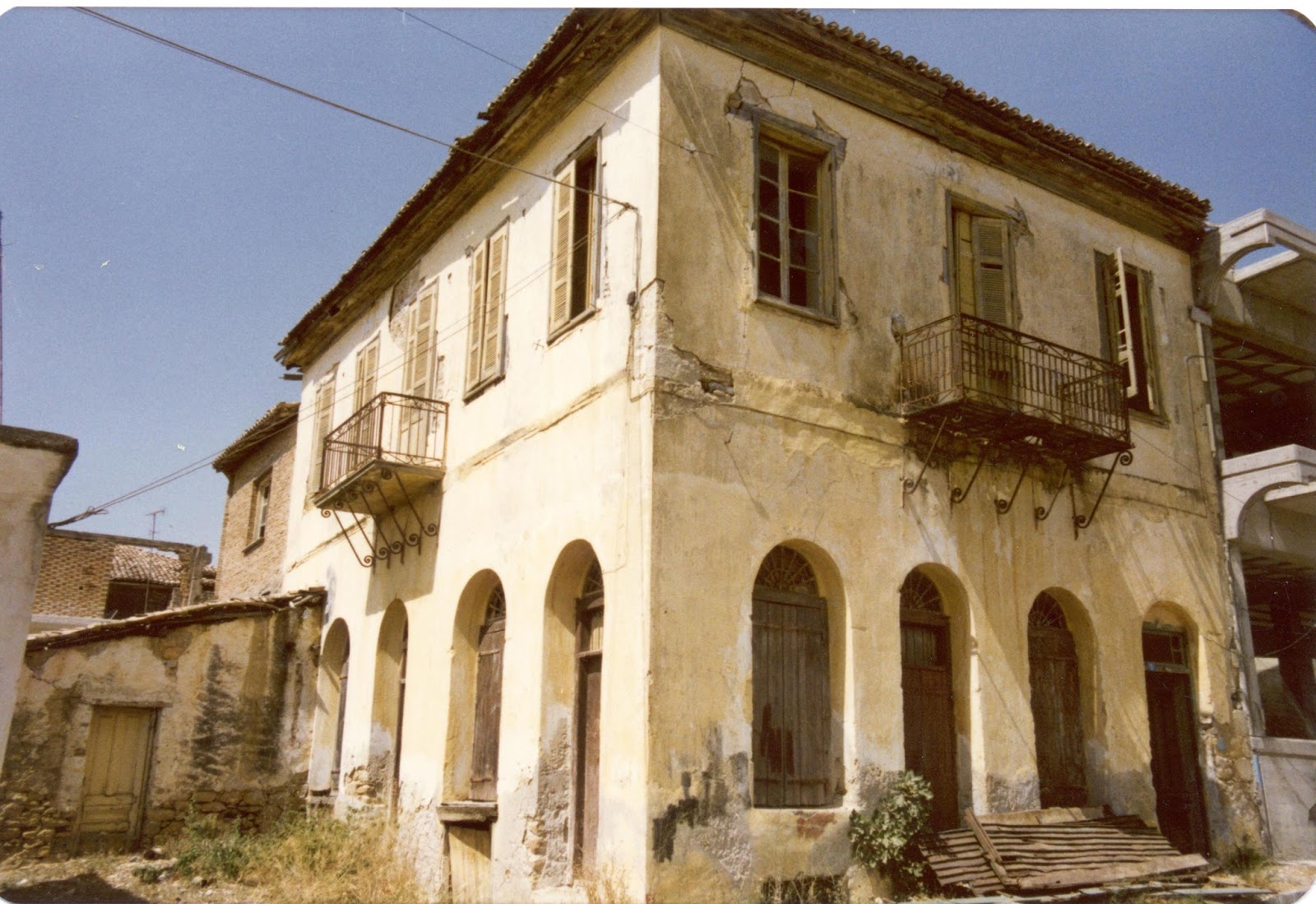
Here is a picture of the original farm house which was built with rammed earth and stone by Rudolph Gaegler in the 1850s or so.


Adam wanted to have a farm to table kind of place which would supply restaurants with fresh produce. Unfortunately his property manager smoked in bed and burned the place down.

At least that’s what my father always told me.

I discovered a more harrowing explanation in a Washington Star article from July 1925.  John Cooley, the property manager and his 35 year old son Jesse were living in an outbuilding on the farm. According to the article, poor Jesse was pumping the kitchen's coal oil stove when it exploded. His clothing caught on fire, and a neighbor severely burned his hands trying to get Jesse’s clothes off. In desperation, Jesse ran to a nearby creek to douse himself, but it was no use. A passing motorist took him to a hospital where he died.
Adam never did move to the farm, and after this unhappy event, he sold both the property and his candy store. He moved the family up to Philadelphia where his wife Katy could be near her folks again and started a coffee company. 

In 1920 Pete bought property on Macomb Street back when the street car turned here off Wisconsin Avenue and trundled on to American University. Not much else was here at the time. Pete filed a permit in 1925 to build a two story building with storefronts and apartments above the shops. 
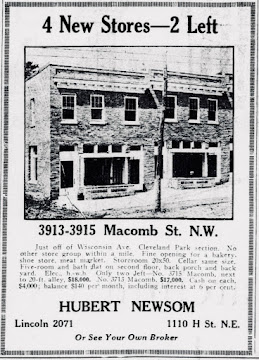

The Cokinos family moved to the apartment at 3709 Macomb. The place had three bedrooms, but the third one was no bigger than a single bed. 

Pete and Pota
Catherine, Nick and George on Macomb in 1927

The first tenants included a hair salon, a druggist, a grocer, a dry cleaner and a hardware shop. My brother Peter remembered a High's Dairy store which sold ice cream when he lived there in the 1940s. Today the whole building houses one restaurant- Cactus Cantina. 

In 1925, Pete opened another candy store, but most of the customers were construction workers from the National Cathedral looking for lunch. Pota would run upstairs and get them soup or a sandwich.  Here's my grandmother hanging out the window of her apartment.


This photo, taken in 1927, shows the building when it backed up to the eighteen hole golf course which was part of the Mclean Estate. (later McLean Gardens)  Evalyn and her husband Ned McLean squandered millions and threw lavish parties on the 75 acre property which included their home, a cast iron swimming pool, and stables.  


Rumor has it that Evalyn allowed her dog to wear the Hope Diamond. Maybe that's why it's now safely stowed in the Smithsonian. 

Pete and Pota converted the candy shop into a lunch room. They called it a cafeteria although it was more like a diner with a few stools and booths. The ad below might send mixed signals, but whatever the dining experience, the room was only one storefront wide.


Unfortunately Pete found out a bit too late that his apartment manager liked to gamble. Pete had to sell part of the building to pay the back taxes. Two Amy's Pizza occupies this space these days. You can see the painted dividing line. 


Meanwhile Alec Cokinos,  Pete's younger brother had moved uptown with Pete. Alec was still a bachelor, but happily for him, the Haramkapolos brothers had just brought their sister Koula over from Greece.  (Not to be confused with my grandmother Pota who was a Haralampakos which might explain why my father was always confused about her maiden name.) 


Alec and Koula were married in 1926 and lived in an apartment over Burka’s Liquor Store for about six years. Their daughter Catherine was born in 1927. Here they are right in front of the building on Macomb with Wisconsin Avenue behind them.


In the early 1930s, another baby was on the way. Alec and Koula became the sextons of St Sophia's church which used to be on 8th and L Street NW. The church provided them with their own digs right next door, and that is where they brought up their family.  According to their son George, their door was always open to neighborhood kids who came by looking for cookies. 


Friday, December 14, 2018

Part Two: How the Cokinos Brothers Found Love

Adam Cokinos, batchelor
The Cokinos Brothers came to America for opportunity. They may not have planned to stay, but by 1911 they had three candy shops going, and I'm thinking it made sense to get married and settle here for good.
Adam was the first of the brothers to find a bride. Greek women were scarce in Washington at the time, but luckily he found Kalliope Condrackos (Katy) in Philadelphia- probably through a candy store connection. He married her in 1912 and brought her back to Washington where they raised a fine crop of girls named Jean, Mary and Thetis.
Pete was the next brother to get hitched. My grandmother Pota Haralampakos had lost her father in Greece and was sent to live with her brother Tom, another candy man, in New Jersey.  My dad always told me that Tom's wife Christine was none too thrilled about the arrangement. I'm guessing none of them were judging by this photo from about 1912.
Fortunately Pete found Pota through the confectioner's grapevine. In July 1914, he took a train up to Elizabeth, New Jersey to get hitched. The two were married at 3 p.m. and promptly took the 6 o' clock train back to D.C.  So much for a honeymoon. No time for wedding pictures either, but this might have been the picture that caught Pete's eye in the first place.
Pota and Pete lived above the candy shop on H Street NE. Their first baby Catherine came along in April 1915- a respectable nine months after their marriage.  In 1916 they bought a nearby row house on 11th Street NE. George was born at home that same year in April, nine months after his parents' first anniversary. Their last child Nick was also born in April a few years later which tells you a thing or two about their matrimonial schedule.

Back at the candy shop,  the children weren't allowed to sample the wares, but George had a powerful sweet tooth. He took to wearing a bulky overcoat with lots of pockets- both during the winter and suspiciously summer, too. This get-up allowed him to become an intrepid shoplifter. He claimed he lost all his baby teeth to his voracious sugar habit, but despite my father's thievery, the stores were a success, and he grew up to have a fine set of choppers.

Cokinos Family on H Street NE abt 1920


Monday, December 10, 2018

Part One : How The Cokinos Brothers Came to D.C.


Once upon a time nine children grew up in a large house in a tiny Greek village called Agulinitsa. The village was very close to the sea and not far from Olympia where the ancient games were held. The family had olive groves and farmland nearby, but three of the brothers, including my grandfather Pete, and his brothers Adam and Alec decided America held more opportunity. 


The first time I visited Agulinitsa in 1988, it just boggled my mind to think of how Pete and his brothers got out of Dodge in the early 1900s. I pictured them riding donkeys or perhaps walking over the mountains, carrying their things in a rucksack. My vivid imagination and horrible sense of history both overlooked the fact of a railroad.  Years later I realized I had missed seeing the tiny station the first time I was there. It was the size of a bus stop. Pete and his brothers only had to walk a few blocks to catch a train to the port of Patras.


Digging into history, I discovered that our cousin James was actually the first Cokinos to arrive from Agulinitsa.  He landed in Wilmington, Delaware in 1903  and worked in the candy business until his cousin Pete joined him two years later. They moved to Washington soon after and opened a confectionary called the Sugar Bowl at 721 8th Street SE. The two lived above the shop and made candy and ice cream in the basement by hand until there was enough money to bring over more family. In 1908 they sent for Adam and opened another store at 1203 H Street NE. The next year Pete and James moved to H Street to make room for James' brother Daniel and Pete's brother Alec. 

Business was booming.
Alec and Pete at 1203 H Street NE abt 1910
The crew soon opened another candy store at 909 41/2 Street SE which I have now learned was not a typo in the DC street directory, but an actual thing. Creative math was part of a 1905 plan to further organize the city on an alphabetical and numerical grid. This street and the neighborhood were eventually wiped out in the 1950s in the name of “urban renewal,”  but now the area has a new baseball stadium and a revitalized waterfront. A nearby historic plaque remembers 4 ½ Street as a major shopping destination in its day. 

4 1/2 Street SW  (Library of Congress) 
In 1910 the Cokinos Brothers opened the last store of their empire.  This one was at 924 9th Street NW - a block from where the ever growing Greek community had just bought property to build St Sophia's church at 8th and L. (Smart cookies, eh?)


Friday, July 07, 2017

Washington D.C. My Hometown -The Musical


Once upon a time not so very long ago, John Landers, a song collector was wandering the land of Google when he tumbled across this blog and sent the above picture. He wondered if I was hip to the swinging version of "Washington, DC.  My Hometown."

What?!!

Yes, D.C., there is a song. Made for our area radio station WWDC to be exact.

Back in the early 1960s, the mad men of "PAMS," the Production Advertising Merchandising Service, came up with the bright idea of making customized "My Hometown" songs for local radio stations. The musical format for each town is basically the same with local attractions plugged into the lyrics.

"The Red Sox and Celtics have both brought Boston fame.
Drive on in on Route Number Nine, you'll be glad you came."

Terry Lee Jenkins seems to have done many of the vocals, and I swear to god the band could be our own Hula Monsters, but these ditties were produced long before their time. Thanks to Youtube you can hear the ones made for PAMS Birmingham, WCAO Baltimore,  WPLO Atlanta, KXOL Fort Worth, Chattanooga, and WCOP Boston.

Sadly Washington's version seems to be lost in the mists of time. I contacted WWDC, but had no luck with their archives. Please let us know if you have the digital or the vinyl. Otherwise we'll have to make up our own words....

Monday, April 03, 2017

Take Me Out


In 1929 my mother Bebe and her little brother Roger Jr lived in the Broadmoor Apartments on Connecticut Avenue. Their parents were the building's first managers, and that brought unexpected perks. Bebe remembered a lot of Senators at the Broadmoor. Not so much the politicians, but  real live baseball players. In the house! The whole family got free passes for games at Griffith Stadium,  and the great pitcher Walter Johnson and my grandfather Roger became friends when he came back to coach the team. 


In 1972, we lost our team to Texas, and my parents never converted to Baltimore.  I don't love sports, but I do like the pace of baseball which allows plenty of time for eating and talking in between (and during) innings.  I will always have a warm spot for the "O's," but  I definitely miss Memorial Stadium where Earl Weaver tended his tomato plants.  If memory serves me, I think it was a dollar for a bag of peanuts on the way in and five for a bleacher seat, and I could always find my friend Dan Elwood commandeering an entire section with a bunch of friends and Budweisers.

Things have come full circle now with a team back in town and a new ball park on the Anacostia.  
Last year my son was lucky enough to score Nats tickets from a friend. He rode his bike to the ball park on a balmy Tuesday night, perhaps starting another tradition of keeping baseball in the family. 

Sunday, December 25, 2016

A Ghost of Christmas Past


Every year I think this is it. This is the year I will sit down and write those pesky Christmas cards. I save the return address labels. I have a box of blank cards. I have a pen, but I never seem to get past perusing the previous year's mail. Poignantly,  I just found a card from Billie Stathes, my father's oldest friend who died about a month ago. They met around 1922 when she was five, and he was six.

Billie at five

Billie lived at 1832 8th Street NW with her parents James and Cleopatra Stathes, her baby brother John and her Uncle George. She called her neighborhood "the village," and her world was anchored by her favorite place, the Carnegie Library. She remembered four gas stations, a variety of shops and the original St Sophia's Greek Orthodox Church were all part of her hood. Billie could also recall the days when the congregation rented space from the Adas Israel Synagogue on 6th and G. This is where she met my father - a zany little boy who loved playing the clown.


Billie and George were lifelong friends; both lived to see ninety and beyond in good health. Even when Billie moved to Florida and became a teacher, they still stayed in touch. She was always beautifully turned out and took no guff.


When Billie came to my dad's funeral in 2008, she gave me a detailed map of her long lost village drawn from her memories and rendered by her cousin Nick Chacos. I was so excited that I took it to the Carnegie Library, but the staff wasn't really sure what to do with it. Feeling the need to share this cool little piece of history, I wrote about it, and six years later, thanks to historian Mara Cherkasky, that posting would lead to Billie's picture landing on a new sign commemorating the old neighborhood near where the Greek church stood at 8th and L NW.

 In 2014, a busload of St Sophia's current parishioners and clergy went on a crazy little field trip to an empty and seemingly soul-less convention room. The only furnishing was a makeshift altar which took on a deeper significance when the crowd discovered they were standing as close as possible to where the original altar stood. (Not an easy trick considering this block of 8th Street is part of the building now.)  After a few prayers, Father Steve led the group chanting through the front hall and out the door to the new sign. Here he thereby sealed the deal by flinging holy water and olive branches around as Greeks are wont to do.

Father Steve Blessing "Billie's" Sign
Billie was thrilled to find out she was included in the project, and that a picture of her and her Uncle George are on the sign.  On that last Christmas card she thanked me for sending her pictures of everything. She was ninety seven when she wrote: "I wept for a week when I saw my village from long ago. I became seven again, getting ready to take my gang to the library for a couple of hours." She was nearing one hundred when she died, still as independent as ever and living at home in Coral Gables.

Next time you are near the convention center "village," look for Billie and her Uncle George and say hello to this little ghost of DC's past.


Saturday, May 28, 2016

Memorialis


Memorial Day plan?

Thinkin' Lincoln I am.

"Lincoln's Cottage" was built in 1842, high on a hill, originally as a summer retreat for local banker George Riggs. In 1851 the property was sold to the U.S. government to become the Old Soldiers' Home, but once the fellows were relocated to a newer building, the cottage was offered to President Buchanan and subsequent presidents as a summer get away.

Lincoln was eager to escape the pressures of the White House in the early 1860s although, ironically, he was an eyewitness to both the recovering and the dead buried on the grounds. He would ride there unaccompanied by guards if he could swing it, and survived having his hat shot off by an unknown assailant one evening during a moonlit commute. I was told by a tour guide that travel time back then was shorter by horseback than it is today by car which tells you something about just how bad our traffic has become.


For years afterwards, the cottage was pressed into service for a variety of uses including as a bar for the retired soldiers which I'll bet Mary Todd tried to haunt with disapproval. Finally in 2008, the house became part of our National Trust as a non-profit historic site open to the public.

This Monday there will be a free wreath laying ceremony at 10 a.m. and tours of the cemetery a bit later. I am happy to report bringing a picnic is encouraged. I also highly recommend getting tickets for the tour of the house where the views of Washington from the original windows let your imagination run wild. Grasp the same railing Lincoln used to walk upstairs and commune with the man who tried his best to save the Union.
No easy task then or now.

Sunday, June 21, 2015

Thanks to My DC Dad


Since I lost my dad some years ago, Father's Day has become a time to remember things. George Cokinos was born at home on 9th Street Northeast to Greek immigrants in 1916. He grew up here and never left the DC area except to travel. We didn't sightsee unless we had out of town guests. We didn't go to the Smithsonian or other museums, but he did leave me an appreciation for living in the District, and I'd like to thank him for many things:

Taking me to the zoo.  A lot.  Sometimes just on the spur of the moment, sometimes for a birthday.  I suspect he liked it because it was uptown, free and outdoors.  I remember he would park our station wagon right near the elephant house and partly on the sidewalk. Crazy, right? He had a little home made sign that he would put on the dashboard which said  "Modern Linen -Making Delivery." That seemed to do the trick.


All those DC stories. George worked mostly in the restaurant world, and he had the low down on how the Italian statues got into AV's yard on New York Avenue, or how Ulysses "Blackie" Auger got his start after World War Two when everyone was craving meat after years of rationing. He sold steaks from the trunk of his car for a short time, but soon opened his own place called "The Minute Grille."  When he had made enough dough to buy the property at 21st and M, he called it Blackie's House of Beef. The kitchen was in terrible shape. One day my father and Uncle Mimi happened by to see the new place, and Blackie asked whether he should spend his money on improving the kitchen or buy a sign. My father said go for the sign, and that's exactly what happened. It was a big sign!


Introducing me to DC centric food 

George always asked for a half smoke over a hotdog. He also liked the fried chicken wing sandwich at the Florida Avenue Grill which came with another story.  Chewing right through the cartilage and spitting out the bones, he would talk about how his parents would have the priest from St Sophia's over for Sunday dinners when he was a kid.  The chicken on the table only went so far with a family of five and an honored guest.  The priest would get the biggest piece, and my grandfather would get the next biggest and so it went.  My grandmother always insisted that "Georgie loved the wing." I guess it happened so many times that he believed it, too.


Teaching me how to drive with impunity. Technically I learned to drive a VW bug with a driver's ed teacher, but my father taught me the finer points of operating a motor vehicle with his mind bending lane changes on the Beltway and sometimes stunning U turns on avenues around the city. Even though he constantly scared the crap out of my mother, he gave me a lot of confidence behind the wheel. And unlike my mother, he taught me how to pump my own gas.

Taking me to see the Watergate concerts.  I feel like I dreamed this, but there once was a floating barge on the Potomac River where concerts were held. The band played on the float, and the audience sat in folding chairs in the road or on the steps leading up hill to the Lincoln Memorial.  After I grew up, I caught the movie "Houseboat" on TV and realized it was the same venue the kids went to with Cary Grant.


It's a good thing they caught that era on film because I can't imagine stopping traffic for anything like that now. Once upon a time the staircase was meant to be part of a grand entrance into the city, but now it's just a strangely marvelous out of place phenomenon on Ohio Drive.


Taking me to Sherrill's Bakery. When I first met the "girls," as George called them, Lola, the owner, started yelling at him in Greek as soon as we walked in. She seemed angry and scary to me.  Her daughters Kiki and Dottie were less frightening, but I didn't know what was going until the scene devolved into pinching cheeks and handing out cookies. They loved my father and were scolding him for not coming by more often.

The bakery was once a mainstay on Capitol Hill and served breakfast, lunch and dinner 364 days a year in a time capsule of a 1940s diner which is when Lola and her husband Sam Rivas bought the place. A cigarette machine and a fortune telling scale flanked the front door, and I thought it was cool we didn't have to pay for the cookies. Former busboy and local film maker David Petersen almost won an Oscar and did win a well deserved Emmy for capturing those crazy and hard working women and their customers in his documentary "Fine Food and Pastries." Hit the link to see it as there's nothing left of Sherrill's except memories now.  Lola worked at the diner until she was 92 years old, but had to quit after a fall.


Showing me how the linen service worked. In the 1950s my dad and my Uncle Mimi started a company called Modern Linen which meant I got to go through the back doors of a lot of restaurants and meet the people in the kitchen. I worked at the laundry in the summertime and saw how all consuming the restaurant biz was.  Customers were constantly having crises. They would run out of clean napkins or dish towels after hours, sometimes a delivery truck would break down, and my brother or a cousins would have to jump in and drive the order in a car. When I decided to be a sign painter my senior year in high school, I think my father thought I was nuts, but he let me paint the trucks, and that was the last time I worked at a laundry. 


Thursday, May 07, 2015

Soliloquy for St Sophia's Greek Orthodox Church


St Sophia Greek Orthodox Cathedral has always been a part of my life. It's the church my family didn't attend. At least, not very often. My grandparents were all in from the get-go and rarely missed a Sunday, but my mother was not Greek which meant she and my father couldn't get married at St Sophia's unless she converted. Plus they both worked at Churchills, our family diner, often until 2 a.m.  And Churchills was open on Sundays.

Still, my dad literally paid his dues to St Sophia's, and we went there for all the important rituals like christenings, funerals and bazaars. A lot of bazaars. My dad always bought raffle tickets for the Cadillac even though in over fifty years he never won and had to buy his own.


Driving down Wisconsin Avenue, it's easy to miss Saint Sophia sitting quietly in the shadow of the National Cathedral on Massachusetts Avenue. The bigger cathedral has held many a state affair, but the staff at St Sophia have waved over a few presidents starting with Dwight D. Eisenhower who laid the cornerstone in 1956.  A time capsule was included and will be opened in 2056. (I'm probably going to miss that event just like I missed this one.)


St Sophia's has seen the likes of Presidents Johnson, Nixon, Ford, and Clinton. Plus a few football players.

(That's Father John- the one without a football or plaid pants)

The church began humbly enough back in the early 1900s when a few hundred Greek immigrants scraped together enough money to rent a room downtown and to hire an itinerant priest. A Washington Star article in 1904 reported "in the heart of the Nation's Capital dwells a community of nearly 500 souls whose lives, customs, religion...are utterly alien to our institutions. It is the Greek colony. They are among us, but not of us."

Wonder where they got that idea?


By 1908 the parish was organized enough to have its own priest and to rent the upstairs of the former Adas Israel Synagogue at 6th and G NW where it remained for 13 years awaiting the construction of their own digs at 8th and L NW.


Though the congregation was small, differences of opinion soon brought on strife courtesy of the Balkan Wars. Father Alexopoulos asked the congregation to take a stand by separating- the Loyalists  had to sit on one side of the church and the Royalists on the other. (talk about division in the aisles) This is why even before St Sophia had its own building, another church, St Helen and Constantine came into being in at 6th and C Street SW.  Father Lambrides, one of St. Sophia's early priests, was so passionate about politics that he vowed to his congregation that he would rather die than celebrate the return of the throne to King Constantine. He had a heart attack that night and died the next day according to his obituary. Wow.

St Sophia finally did land at 8th and L in 1921 and stayed put for 34 years. The convention center has swallowed those blocks now- including part of 8th Street.  A commemorative marker stands nearby on 7th Street and was blessed by Father Steve last fall in a ceremony held in room 140A exactly where the original nave of the old St Sophia's was.


Even the sign got baptized.


photo by Bill Petros
The new Cathedral was dreamed up in the late 1940s as the congregation grew. Property was bought at 34th and Massachusetts, and the ground was blessed in 1950, though the church wouldn't be ready until 1955, and the plain walls would take many more years to adorn.


The founders in the weeds of the new site of St Sophia


This weekend St Sophia will celebrate its 60th year on Massachusetts Avenue and will be consecrated with as much hoopla as only Greeks can muster complete with saint's bones, incense and a whole lot of chanting. If you have ever been to a Greek ceremony you know this will take all weekend. Every inch of the cathedral has been transformed into a beautiful work of art, built with many years of hard work and long term dreams.